Walsh B and Guiliano KK.
QAPI 176: Improving Diagnostic Accuracy: Evidence-Based Strategies to Decrease ED Blood Culture Contamination.
American Journal of Infection Control, Volume 54, Issue 6, S79. June 2026.
June 2026
Background
- Blood culture contamination is a persistent problem in emergency departments (EDs), contributing to unnecessary antibiotic exposure, excessive diagnostic testing, and increased length of stay.
- National benchmarks define <3% contamination as acceptable, yet emerging evidence supports a more ambitious goal of ≤1%.
- In early 2023, contamination rates at two EDs within a two-hospital system exceeded
Methods
- This project was conducted in two busy EDs (44,000–60,000 annual visits).
- A baseline one-week audit found multiple failure points including inadequate skin antisepsis, lack of initial blood diversion, syringe draws, improper fill volumes, and inconsistent bottle inoculation techniques.
- A multifaceted intervention began in June 2023 and included:
- Standardized blood culture collection kits
- Adoption of a passive BDD (Kurin Lock®)
- Targeted staff education and hands-on competency training
- Elimination of line draws
- Real-time feedback with follow-up for contamination events.
Results
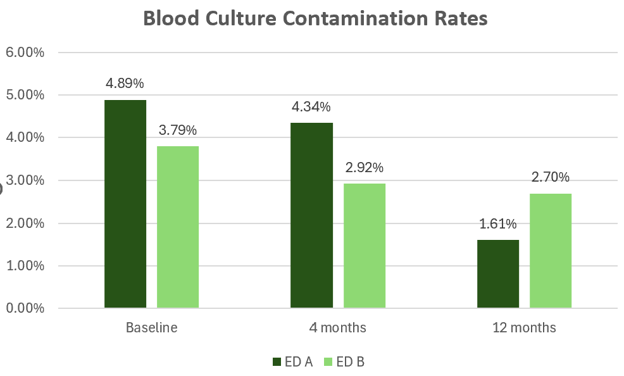
- Contamination rates were evaluated for 12 months pre-intervention, during a 4-month pilot (Sept–Dec 2023), and over 12 months post-implementation.
- These rates are displayed on Figure 1.
- Overall, there was a 67% decrease in ED A and a 29% decrease in ED B.
- No missed bacteremias or adverse events occurred.
Conclusions
- Standardizing Blood culture contamination practices combined with implementation of a diversion device substantially reduced ED blood culture contamination rates.
- Contamination rates approaching the ≤1% target are achievable in high-volume emergency departments when evidence-based technology is paired with staff education and competency validation.
- Ongoing monitoring and real-time feedback helped sustain improvements, highlighting the importance of the continuous quality improvement process.
Practice Implications
- Reducing blood culture contamination supports diagnostic and antimicrobial stewardship by decreasing unnecessary antibiotics, repeat testing, and avoidable healthcare utilization.
- These findings support incorporating standardized kits, diversion devices, and ongoing feedback into ED protocols as part of broader diagnostic stewardship and patient safety initiatives.
- Embedding standardized blood culture collection protocols into orientation, annual competencies, and ongoing staff training can promote long-term adherence to best practices and help to sustain low blood culture contamination rates.
Related Studies
No items found.