Automatic Diversion Outperforms Waste Tubes: BCC Rates with Kurin Decreased 80%
July 2026
How closed-system automatic diversion devices outperform manual open waste tube techniques in clinical practice.
The aim of blood culture diversion is to sideline initial blood away from the collection vessel to reduce the chances that blood contaminated with skin flora is sent to the laboratory for culture.38,95,59 The principle is similar to the collection of a midstream urine sample, where the initial flow of urine, which is most likely to be contaminated, is discarded.
Hospitals often trial waste tube diversion citing the availability of standard, inexpensive vacuum tubes already in stock. However, the challenges of manual waste tubes are numerous.96 Clinicians must disinfect the tube top, insert the tube into the specimen bottle holder, wait for it to fill, remove it, and then insert the blood culture bottle. In busy hospital environments, nurses may suffer from discipline fatigue. The process also introduces extra physical touchpoints which increase the risk of specimen contamination.
In a study at Crouse Hospital, Allain30 illustrated how automatic diversion outperforms waste tubes. After trialing waste tubes with ongoing staff education, the facility transitioned to automatic diversion (Kurin Lock) citing greater efficiency for phlebotomists. With Kurin, Crouse reduced their contamination rate to 0.8%. Likewise, Biddle and Whitis17 compared BCC reduction strategies across two emergency departments at a Level I trauma center utilizing a passive diversion device and a community hospital utilizing waste tubes. The trauma center achieved an almost 2x greater reduction in BCC (33% vs 18%), indicating that the automatic diversion device outperformed waste tubes despite a more complex, high-acuity environment. The estimated ROI of the automatic device was almost 3x that of the waste tubes, despite a higher upfront investment cost.
line
Setting
A 500-bed acute care facility with a 34-bed Emergency Department (ED) collects 9,000 blood cultures annually. Despite ongoing education on aseptic technique and the use of waste tubes for manual diversion of initial blood, blood culture contamination (BCC) rates remained elevated at 5.6%. ED leadership and clinicians sought to improve rates.
Method
ED leadership and ED educators collaborated to implement a standardized blood culture collection process using Kurin collection sets with an integrated automatic diversion device to help reduce BCC.
Kurin automatic diversion out preformed manual waste tube diversion reducing BCC by 80.3%
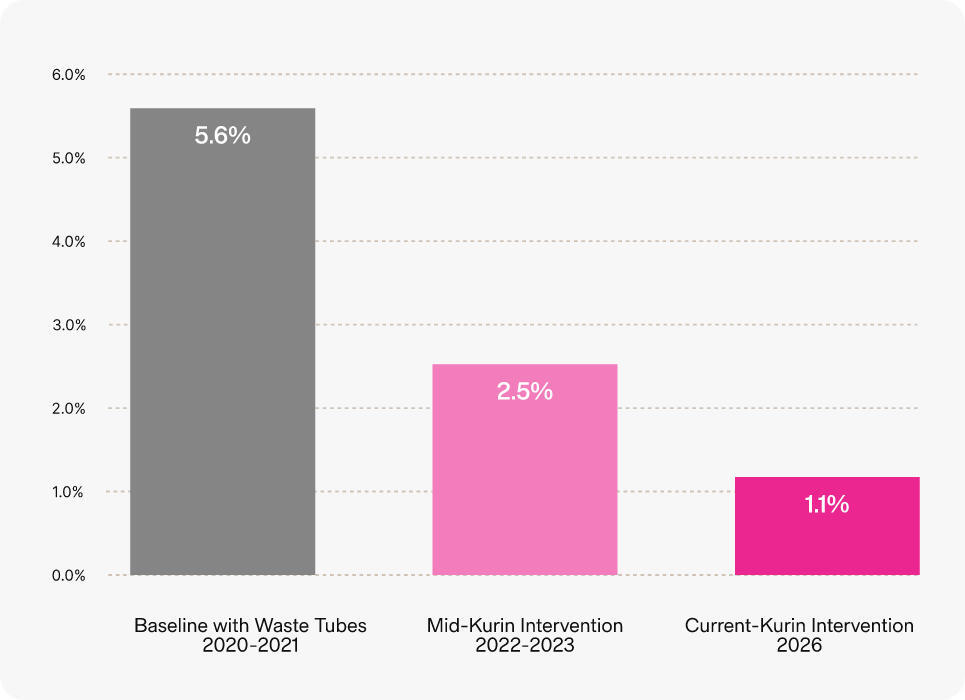
Over a 6-year period this Magnet-designated hospital studied its blood culture contamination rates, beginning with data reflecting a baseline BCC rate of 5.6% when collection policy required the use of manual diversion with waste tubes (2020-2021). After introducing Kurin automatic diversion sets, the BCC rate fell 55.4% to a rate of 2.5% in 2022-2023. By 2026, the rate had fallen another 56% hitting the 1.1% target. The total rate reduction with Kurin was 80.4% below the waste tube baseline.
Key Takeaways:
Implementation of Kurin supported by best practices was associated with an 80.4% reduction in BCC rates and sustained performance averaging 1.1%
- 1.1% BCC rate with Kurin is 80.4% lower than the rate with waste tubes
Blood culture contamination rate fell from 5.6% with waste tube discard to just 1.1% with Kurin automatic diversion.
- $4.73 million reduction in avoidable costs
In the 4 years since the hospital implemented Kurin to reduce BCC rates, the facility estimates total cost avoidance at $4.73 million.
- 4 years of sustained results with Kurin automatic diversion
The use of Kurin diversion with collection best practices has yielded long-term reduction in contamination rates driving the hospital-wide rate to the 1% target.