Conversion to Clinician-Preferred Kurin® Automatic Diversion Achieves 62% Decrease in House-Wide BCC.
August 2026
Selecting blood culture diversion technology for optimal clinical acceptance and compliance
Diversion devices have been proven to reduce blood culture contamination without reducing detection of true infection.95,96 Some initial specimen diversion devices (ISDD) may add complexity to specimen collection. For this reason, diversion device selection is critically important.
In clinical study, nurses and phlebotomists prefer automatic blood diversion which passively sidelines the initial aliquot of blood during draws to avoid skin contaminants over manual methods. Automatic diversion is faster and requires fewer steps thereby increasing clinician compliance. When diversion is used, blood culture contamination (BCC) declines. A diversion device integrated into a familiar collection set requires no change in collection practice. Conversely, manual devices require the user to manually squeeze/click a mechanism to redirect flow and to manage a bulkier device.
In a 2024 study,12 the authors reported that 73% of healthcare staff considered diversion with the manual multi-step Steripath® device worse than the standard collection process. In comparison, automatic diversion with Kurin achieved higher user acceptance with only 30% considering it worse than the standard collection process. “The need for the phlebotomist to activate the Steripath by squeezing the device created complications for some users. No device failures were reported with Kurin.” Likewise, in a survey of phlebotomists published in 2026,97 respondents revealed low staff satisfaction with two manual Steripath devices. “Staff reported multiple ergonomic barriers limiting the Steripath ISDD’s utility, which precluded implementation of the Steripath-DTM in routine clinical practice.”
line
Setting
Emergency department (ED) staff collect blood cultures while a phlebotomy team performs collections in the rest of the hospital. The facility set a long-term target of a 1% BCC rate, a significant decline from its historical house-wide rates of 3-4%.
Method
A trial of a manual multi-step diversion device (Steripath®) was abandoned when nurses found using the device too complicated. Then, an automatic diversion device (Kurin Blood Culture Collection Sets) was implemented, which passively sidelines skin contaminants without changing collection practice. The Kurin device was received with high clinician acceptance and preference.
Compliant use of Kurin’s clinician-preferred diversion device reduced the BCC rate 62% to a rate of 1.4%
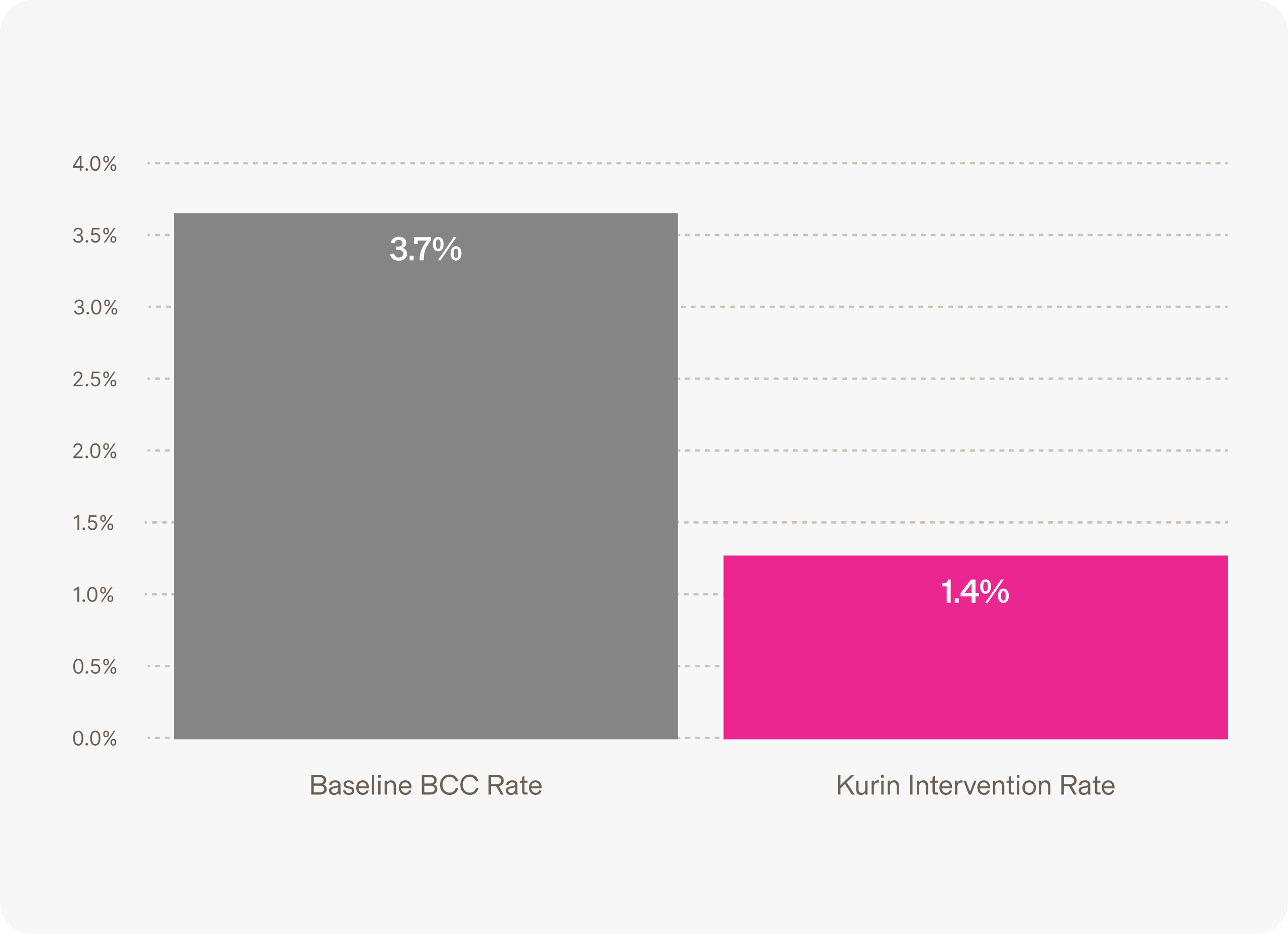
Manual diversion technology failed to achieve the 1% BCC target set by hospital leadership due to poor acceptance by the clinical staff. With the subsequent introduction of Kurin blood culture collection sets, the emergency department staff and phlebotomists reduced the house-wide BCC rate from 3.7% to 1.4%, achieving a 62% decrease in contaminated cultures. The facility estimated that each BCC resulted in $3,700 in cost avoidance, generating significant savings for the organization.
Key Takeaway
By converting to a clinician-preferred diversion device that streamlines workflow with passive technology, ED nurses and phlebotomists are driving toward a 1% BCC rate.
- 62% reduction has been consistently achieved for 3+ years nearing the 1% target.
The facility’s baseline BBC rate exceeded the 3% benchmark despite having tried a manual diversion device (Steripath). With Kurin, the clinician-preferred diversion device, the facility drove the rate down to 1.4%, approaching their 1% goal.
- $37,000 in savings for every 10 false positive results avoided.
Contaminated cultures add cost to patient care in the form of additional tests, increased length of stay, and potential complications and adverse events. The facility estimated these costs at $3,700 per BCC.
- The facility found success with Kurin after manual diversion failed to gain user acceptance.
The facility initially conducted a trial of a manual multi-step diversion device, but the clinicians found it to be too complicated. The passive workflow of Kurin diversion met clinician demands and increased user compliance.